ETF Reporting Platform

Turn hours of ETF reporting into seconds — with reliable data and full traceability.

Asset Management · Built on CAIT.tech · Powered by the Claude tech stack

The ETF Reporting Platform brings ETF data, reporting, fund management, AI-powered analysis, and auditability into one governed environment. Built around a real ETF workflow, the current pilot already delivers the core reporting engine end to end. The same foundation can be extended around each client's own data sources, validation rules, report templates, workflows, and reporting needs.

The problem

ETF reporting often depends on a fragmented mix of custodian files, market-data feeds, spreadsheets, databases, and manual controls.

1

Fragmented data

Different providers deliver data in different formats, structures, and schedules, making it difficult to maintain one consistent reporting process.

2

Manual reporting

Analysts spend significant time reviewing files, transferring figures, recalculating metrics, and preparing recurring reports by hand.

3

Data issues discovered too late

Missing, malformed, or inconsistent data may only become visible during report preparation, creating additional checks and rework when deadlines are already approaching.

4

Limited traceability and scalability

Figures are spread across multiple files and workbooks, making them difficult to trace back to their source. As more funds, data sources, and reports are added, the same manual workload grows with them.

One governed data foundation

The platform creates a controlled flow from incoming data to reporting, analytics, and client-facing outputs.

Ingest→
Validate→
Structure→
Report→
Analyze

Data can enter through files, databases, APIs, or other client-specific sources. It is validated against defined rules, stored in a structured financial data layer, and made available across reporting, fund management, audit history, and AI-powered analysis.

Instead of maintaining separate processes for each source or report, teams work from the same validated data foundation — with traceability and controls built into the workflow.

By the numbers

Current pilot

5File types — Daily NAV, EOD Holdings, Monthly Performance, SEC Yield, and market-price/bid-ask
3Formats — CSV, TXT, and XLSX, with no manual field mapping
100%Source traceability — reported data linked back to its original upload batch
~8 daysFrom specification to a working end-to-end pilot

Inside the platform

Each module already runs end to end in the current pilot, and can be adapted to each client's own systems and requirements.

Data ingestion

Current pilot

A single upload interface accepts CSV and fixed-width TXT files of up to 50 MB. 5 ETF file types are recognized automatically by naming pattern. Incoming files are validated before their records enter the reporting database.

Adaptable to each client

The same ingestion layer can connect to existing databases, APIs, automated feeds, additional file formats, and proprietary data sources.
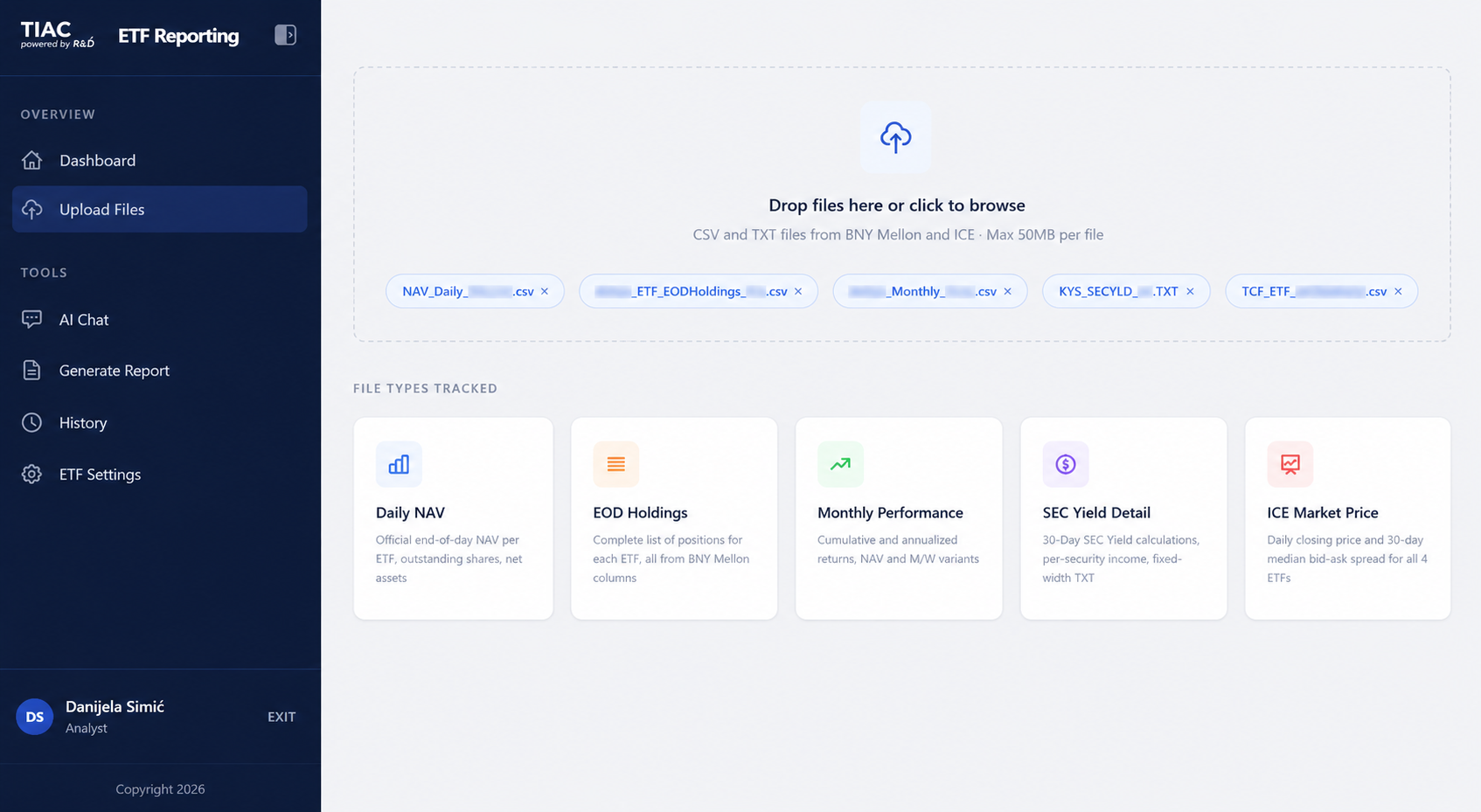
ETF Reporting Platform data ingestion screen

Reporting

Current pilot

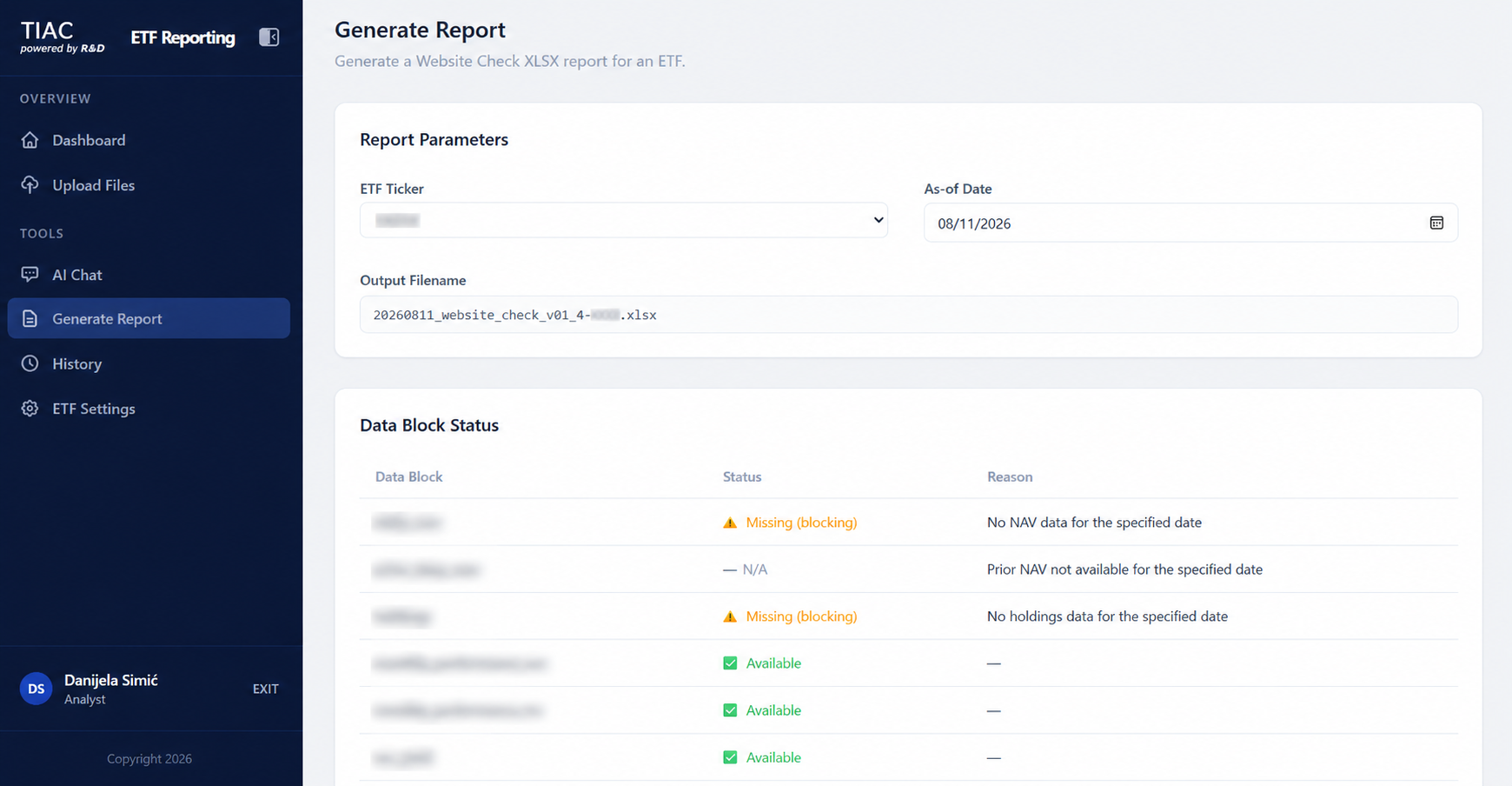
Internal control reports are generated on demand as XLSX files based on a predefined template. Before generation, a Data Block Status panel identifies each required input as Available, Missing, or N/A, making data gaps visible before they affect the report.

Adaptable to each client

Reporting can be configured around each client's templates, calculations, approval workflows, and reporting cadence — with support for multiple report types, automated scheduling, and different output formats.

ETF Reporting Platform reporting screen

ETF management

Current pilot

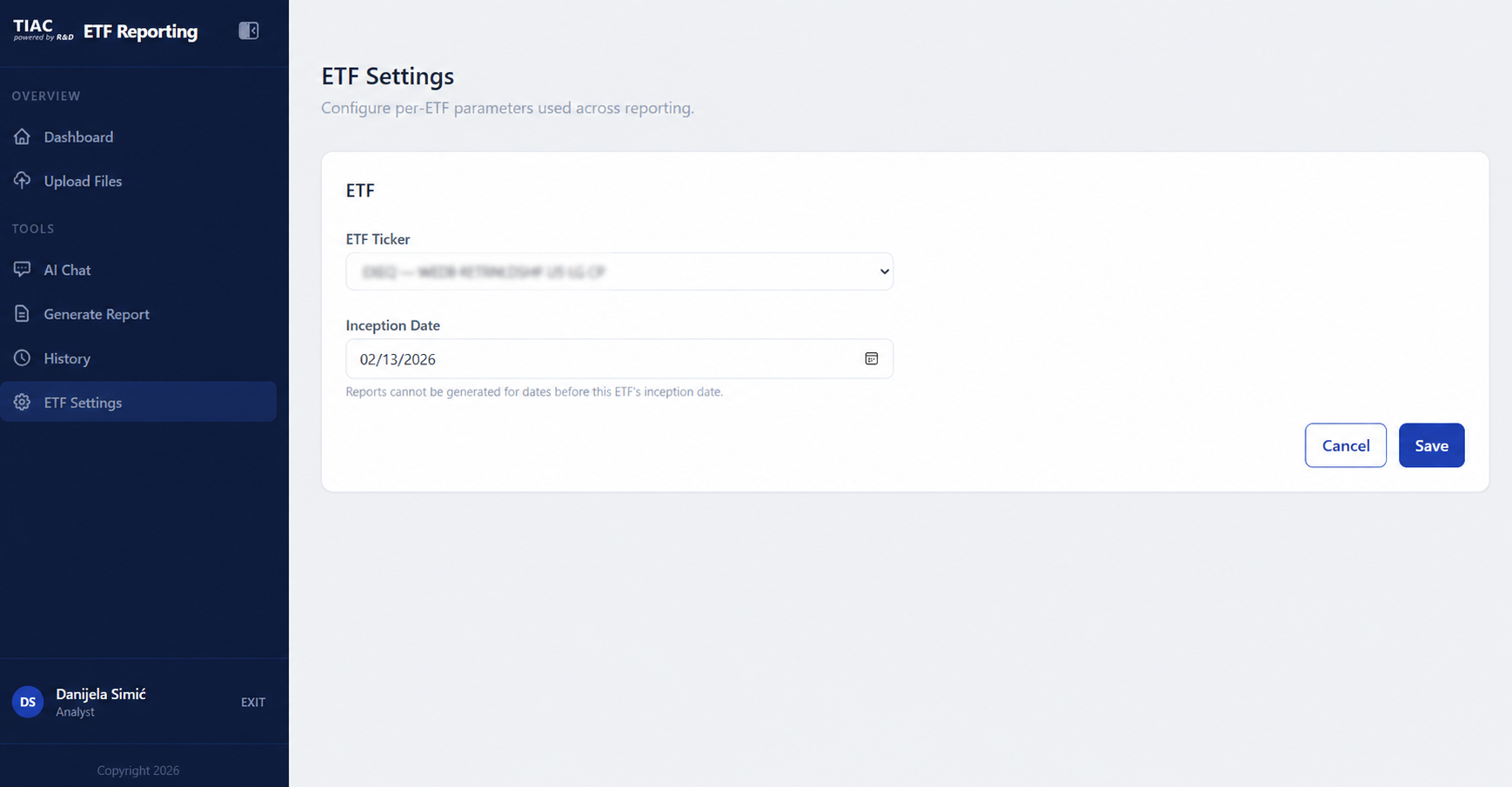
Fund-specific parameters, including inception dates, are managed centrally and applied throughout the reporting workflow. Built-in controls help ensure reports are generated only for valid fund periods.

Adaptable to each client

The fund management module can expand into a central workspace for managing both existing and future ETFs. Teams can easily add and update fund names, descriptions, logos, supporting documents, account details, and other fund-specific information from one place. Changes can then flow directly to the client-facing portal, keeping internal records and externally published fund information aligned.

ETF Reporting Platform ETF management screen

Natural language data analysis

Current pilot

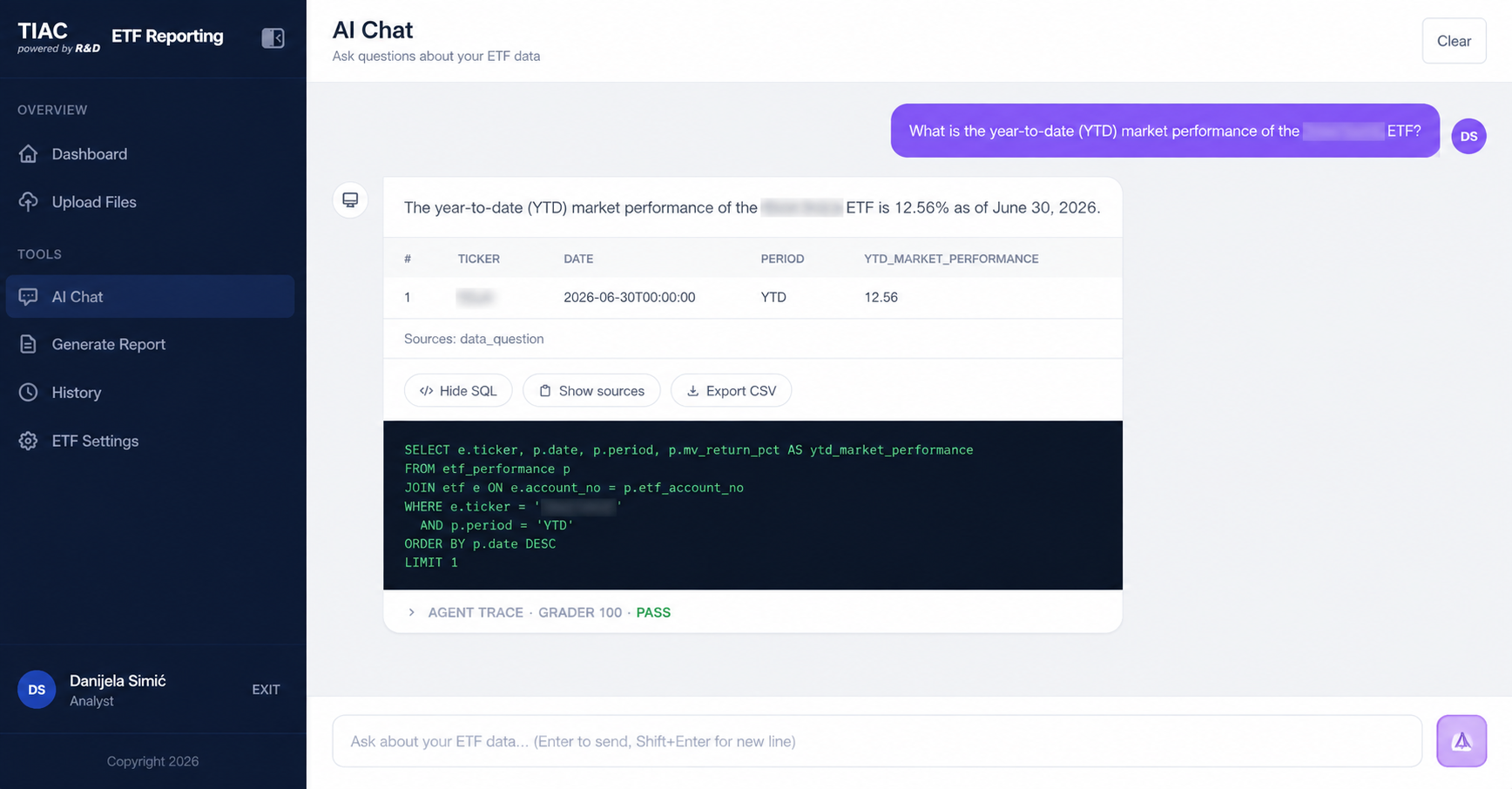
Analysts can ask questions about ETF data in plain English and receive clear, data-backed answers directly from the reporting database. The conversational layer operates in read-only mode, while users can review supporting data, trace sources, and export results for further analysis.

Adaptable to each client

The conversational layer can expand to support cross-fund and ETF performance analysis, dashboards, charts and visualizations, richer queries, and report generation through natural language. Selected roles can also be granted controlled permissions to correct or complete missing or inaccurate data, with changes governed by access and audit controls.

ETF Reporting Platform AI chat screen

History & audit

Current pilot

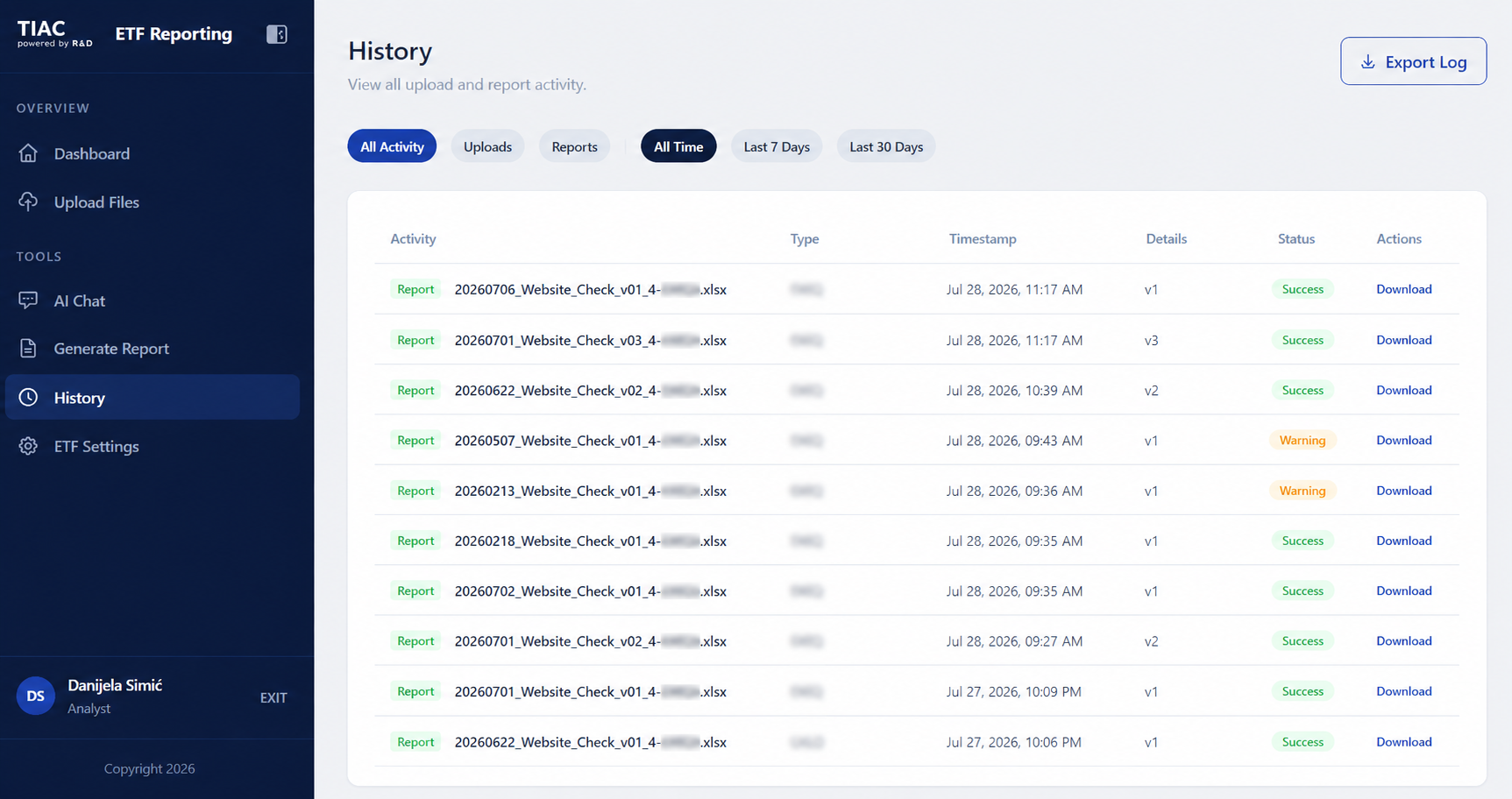
Every upload and generated report is recorded in a centralized activity history. Users can filter activity, download previous files, export the log, and review processing runs marked as Success or Warning. Reported data remains traceable back to its original upload batch.

Adaptable to each client

The audit layer can extend across automated feeds, scheduled reports, user activity, AI interactions, configuration changes, and other reporting workflows.

ETF Reporting Platform history and audit screen

Governance & control

The platform is designed to keep data, reporting, and AI activity within the same governed environment. Depending on client requirements, this can include role-based access, data-access policies, AI governance, usage and cost tracking, security controls, and approval workflows.

Client-facing reporting

The same validated data foundation can also support external reporting experiences. Depending on the use case, clients can expose selected fund information, reporting outputs, or real-time data through their own website or portal — using the same governed data that supports internal operations.

Built on CAIT.tech

~8 daysworking days to deliver
12implementation tickets
12table financial data schema
51unit tests

The platform was built using AI within a structured, governed engineering process. A CAIT planner agent translated the initial specification into a phased, ticket-by-ticket implementation plan. Claude coding agents, connected through MCP, supported development across each ticket, while outputs were continuously evaluated against a predefined evaluation harness before progressing further.

Human review remained part of the process throughout, with every pull request requiring approval before being accepted — the development process stayed fully under human ownership.

Learn more about CAIT.tech →

Real people. Real expertise. Real results.

AI gives experienced teams better tools to automate repetitive work, move faster, and focus their expertise on the decisions that require human judgment.

Back to the TIAC AI PoC Program